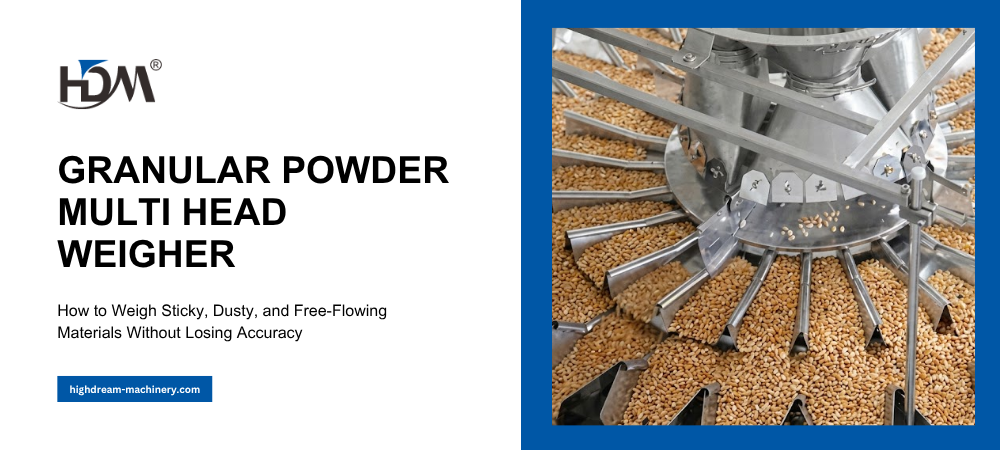
In chemical compounding and continuous process lines, powder behavior doesn’t stay constant. Carbon black aerates. Pigments bridge. Fine additives shift in bulk density without warning. By the time a dosing error shows up in a batch test, it’s already in the product — because there’s no fill-station checkpoint to catch it upstream.
Most powder weighing and filling machines are designed for packaging stations: portioning product into containers at a fixed fill weight. They’re not engineered for continuous process dosing where material density varies and bridging stops flow mid-run. Gravimetric loss-in-weight feeders are — and for cohesive, hard-to-flow chemical powders, the twin screw configuration is the standard choice. This guide covers High Dream’s twin screw LIW feeder range and how it addresses the dosing challenges most common in chemical and industrial powder applications.
Packaging filling machines operate batch-by-batch: each cycle fills one container, the operator checks weight, and the line moves on. Errors are caught at the fill station. In a continuous chemical process — a twin-screw compounding extruder running at 600 rpm, a polymerization line, a battery electrode slurry system — there is no fill-station checkpoint. A dosing error at the feeder propagates directly into the product.
Chemical powders present a specific set of challenges that standard volumetric filling equipment is not built to handle:
A volumetric feeder — one that counts screw rotations to estimate volume — assumes bulk density is constant. In chemical processing, that assumption fails regularly. The result is off-spec product, material waste, and unplanned downtime.
A loss-in-weight feeder places the entire hopper and feeding mechanism on precision load cells. The controller monitors the rate at which the total assembly weight decreases — that rate is the actual feed rate in real time. A PID control loop continuously adjusts screw speed to maintain the target feed rate, regardless of what the material is doing inside the hopper.
This closed-loop gravimetric control is what separates LIW feeders from volumetric systems:
High Dream’s LIW feeders use a dual-loop feedback control system — combining gravimetric (weight-based) and tachometric (speed-based) feedback — managed through a 7-inch touchscreen controller.
添加yt影片https://www.youtube.com/watch?v=AcIUsG5gc2A
Not all loss-in-weight feeders are configured the same way. The feeding element inside the LIW feeder — twin screw, single screw, vibratory tray, or belt — determines whether the system can actually handle your material reliably.
For the powders most common in chemical processing, twin screw is the default recommendation. The counter-rotating, interlocking screws continuously agitate material at the outlet, preventing the bridging and arching that causes single-screw systems to stall on cohesive materials. High Dream’s twin screw models include a dedicated anti-bridging agitator specifically designed for chemical industry feed rates and material characteristics.
|
|
|
|
|
|
|
|
|
|
|
|
|
|
|
|
|
|
|
|
High Dream's twin screw LIW feeder line uses dual servo motor drives, allowing independent adjustment of screw speed and agitation frequency. This matters for materials like carbon black where the optimal agitation intensity is not simply proportional to the feed rate.
Matila is famous for manufacturing film blowing machines. Besides,it has 40 years experience in manufacture and design the Blown Film Machine.In order to control the quality when the film is blown, Matila (Jiangsu) has its own design and manufacture team of die head.Furthermore, Matila (Jiangsu) controls the manufactured quality at all times, it has lathe machines, milling machines and drilling machines.It already has extensive experience in mass production and customized the Blown Film Die Head.
8-2 Xingyuan Road,Jingling Sports Industrial Park,Nanfeng Town,Zhangjiagang City,Jiangsu Province,China.